

May 8, 2025
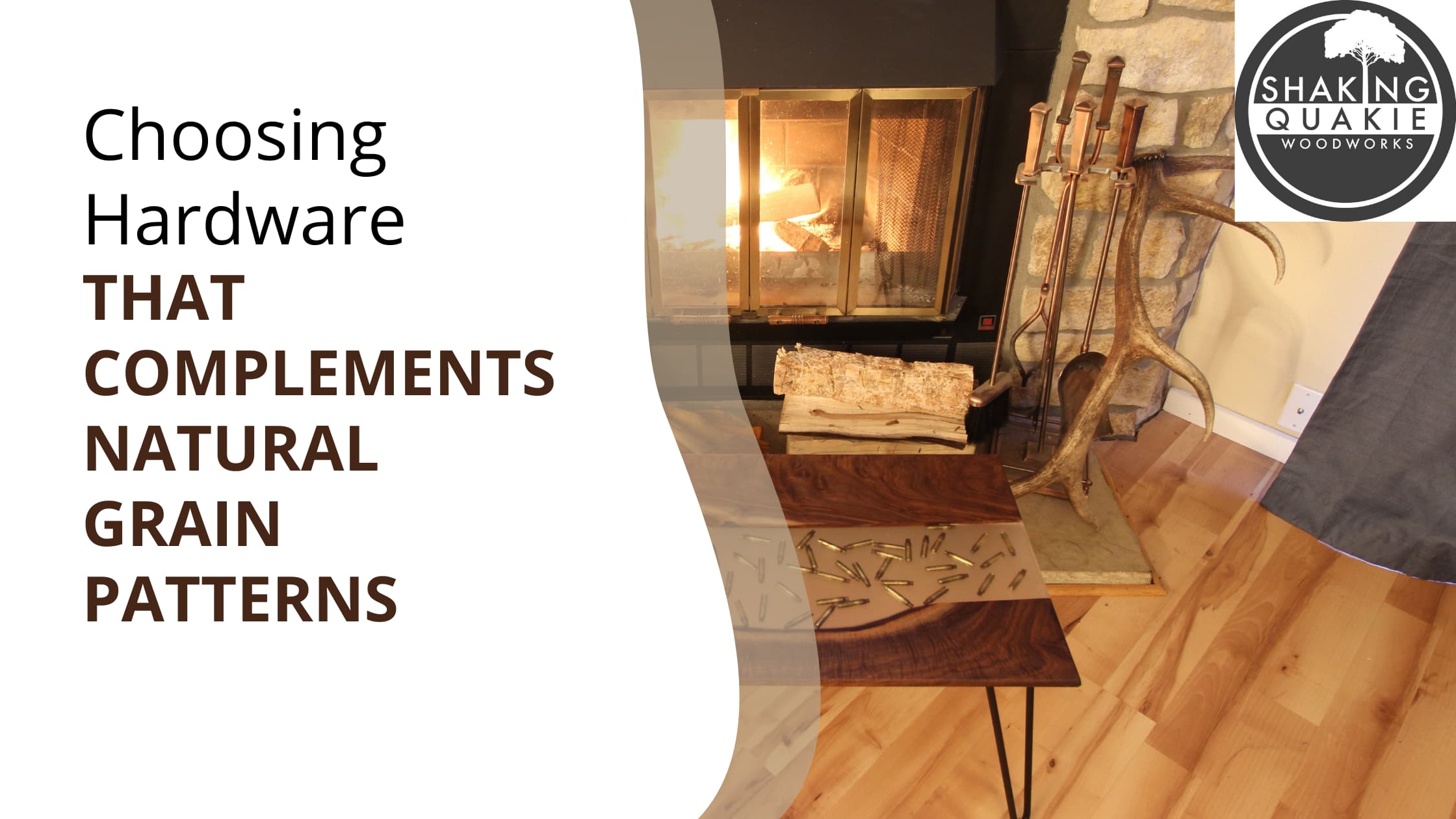
You've chosen the perfect wood—walnut, white oak, maybe a live-edge slab of reclaimed elm. The grain is rich, the texture alive. But there’s one decision still ahead that can either elevate your piece or distract from its beauty: the hardware.
Whether it’s a drawer pull, cabinet knob, hinge, bracket, or door handle, the hardware is the handshake of your woodwork. It’s the part that gets touched every day. It’s also the design element most likely to clash if chosen poorly or disappear if chosen generically.
At Shaking Quakie Woodworks, we approach hardware selection the same way we approach joinery or finishing: with intention. This guide explores how to choose hardware that doesn’t just “match”—but actually enhances the natural grain of your wood, supports the story of the piece, and brings function and form into perfect balance.
Grain patterns are one of the most distinctive and expressive elements of hardwood. They vary by species, cut, and age, giving each board its own fingerprint.
Here’s what natural grain can do in a piece:
The right hardware doesn’t compete with these elements—it coexists with them. Done right, it frames the grain rather than fights it.
Before choosing hardware, look at what the wood is telling you. Ask these questions:
If the wood itself includes strong sapwood/heartwood contrast (as in walnut), consider a neutral or matte finish to avoid adding competing shine.
Not all hardware serves the same purpose. Here’s how we match hardware style to both grain and function.
Pulls should complement the linear motion of drawers and doors. We love using:
Tip: If your drawers have horizontal grain, orient your pulls horizontally. It reinforces the direction and flow.
Knobs are less dominant than pulls, which makes them great for pieces with busy or active grain.
Use knobs when:
For high-figure woods like curly maple or spalted elm, consider low-sheen, small-profile knobs in solid metal or leather-wrapped options.
In furniture with visible joinery—like exposed hinges on vanities or gate-leg tables—hinges become part of the aesthetic.
Function matters here, too. If a piece is heavy or oversized, go with robust, load-bearing hardware—even if it adds a little visual weight.
Accent hardware is where you can have a little fun—especially on shelving or open furniture.
Consider:
Always match the tone and sheen to the wood’s finish. If your finish is satin, avoid polished chrome. If your wood is raw or oiled, avoid ultra-reflective hardware.
Not all metals are created equal—at least when it comes to pairing them with wood. Here’s a cheat sheet to help you match common wood species with harmonious metal tones:
Note: Mixing metals in one piece can work—but it takes care. If you're blending black and brass, make sure the woods are simple and the forms are clean.
Hardware also influences how you interact with a piece. It affects:
We recommend test-fitting hardware on sample boards when possible. It’s one thing to like how it looks on paper—it’s another to love how it feels in your hand every day.
Sometimes a piece demands more than off-the-shelf options. That’s when we collaborate with local metalworkers or source artisan hardware from small-batch makers.
Custom options include:
We often recommend this route when the wood has historic significance (reclaimed material) or when the hardware plays a central design role.
We once built a white oak sideboard with a soft matte finish and vertical slatted doors. The grain was quarter-sawn, giving it that signature ray fleck that danced across the panels in the afternoon light.
Our client originally selected shiny chrome pulls. On the sample board, they felt… off.
Instead, we recommended thin matte black tab pulls, recessed into the door edges so nothing interrupted the vertical lines. The result? A piece that was quiet, sophisticated, and deeply harmonious.
They later told us, “I didn’t even know hardware could feel that right.”
Wood is a living material, filled with stories written in grain and growth rings. Hardware is how we finish the sentence, not how we start it.
At Shaking Quakie Woodworks, we believe in crafting pieces where every detail—down to the hinges and handles—feels intentional. Whether we’re building a rustic vanity from reclaimed beams or a minimalist sideboard in maple, we treat hardware not as an afterthought, but as a vital part of the story.

.svg)
.svg)
